Two Roberts
One Bohemia of their own making

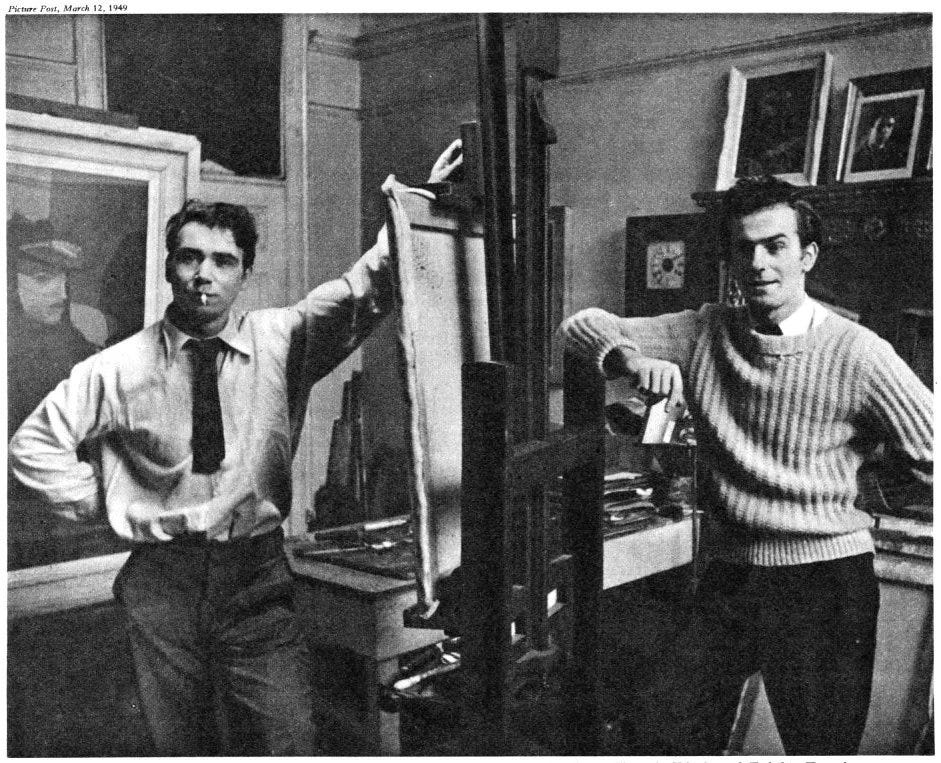
From 1976 to 1982, I attended Kilmarnock Academy in Ayrshire. The school had existed in some form or another since the 1630s, but by the time I was a pupil, this sprawling secondary school perched high above the town centre consisted of a hotchpotch of buildings from various eras knitted-together to form a campus capable of containing thousands of post-war baby boomers.
Until 1945, Kilmarnock Academy had been a fee paying school. After World War Two, it became a state-run co-educational grammar school. Its reputation until it became a comprehensive in 1968 was that it was the school for brainy kids in Kilmarnock and outlying areas who passed the 11 plus.
Famous former pupils from Kilmarnock Academy’s Brain of Britain heyday included not one, but two scientists who went on to become Nobel Laureates. Darvel-born Alexander Fleming changed modern medicine with his discovery of penicillin, winning the 1945 Nobel Prize in Physiology or Medicine, while John Boyd Orr, who was born in Kilmaurs (me too), won the Nobel Prize for Peace in 1949 for his pioneering research and activism around tackling hunger on a world stage. Take that Eton!
The painter Robert Colquhoun must have been a clever lad as he attended my old school in the late 1920s and early 1930s.
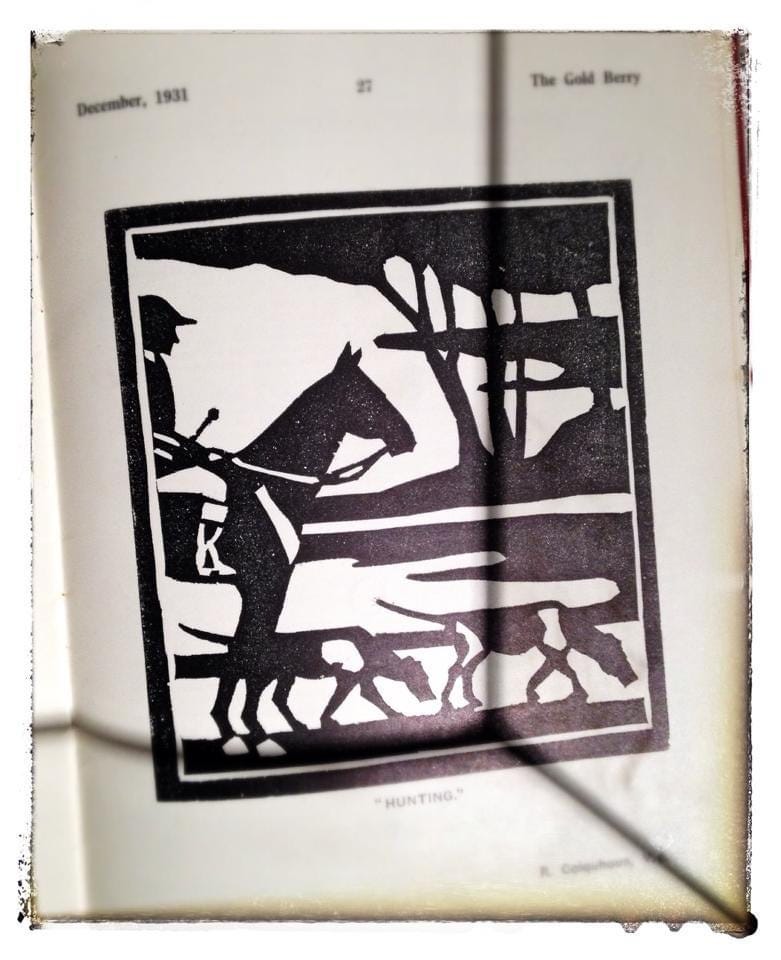
Colquhoun excelled in art at Kilmarnock Academy (see above) and went on to win a scholarship to study at Glasgow School of Art. It was there, on their first day at the world-famous art school in 1933, he met his life partner and fellow Ayrshire lad, Robert MacBryde.
Together, the two men became known as The Two Roberts. For a while, they were the toast of London’s Bohemian post-war art scene, but their star burned out with their early deaths within four years of each other in 1962 and 1966 respectively.
After being introduced to Colquhoun & MacBryde’s work by Davy Brown, my art teacher in fifth year at Kilmarnock Academy, I’ve had an enduring fascination with the Two Roberts’ work – and their story.
Davy also attended Kilmarnock Academy, where he was taught by John (Jock) McKissock, a contemporary of the Two Roberts at GSA. Mr McKissock was still head of art when I started at Kilmarnock Academy, but had retired by the time I was spending all my spare time in ‘the old tech building’ drawing decaying pomegranates and the like.
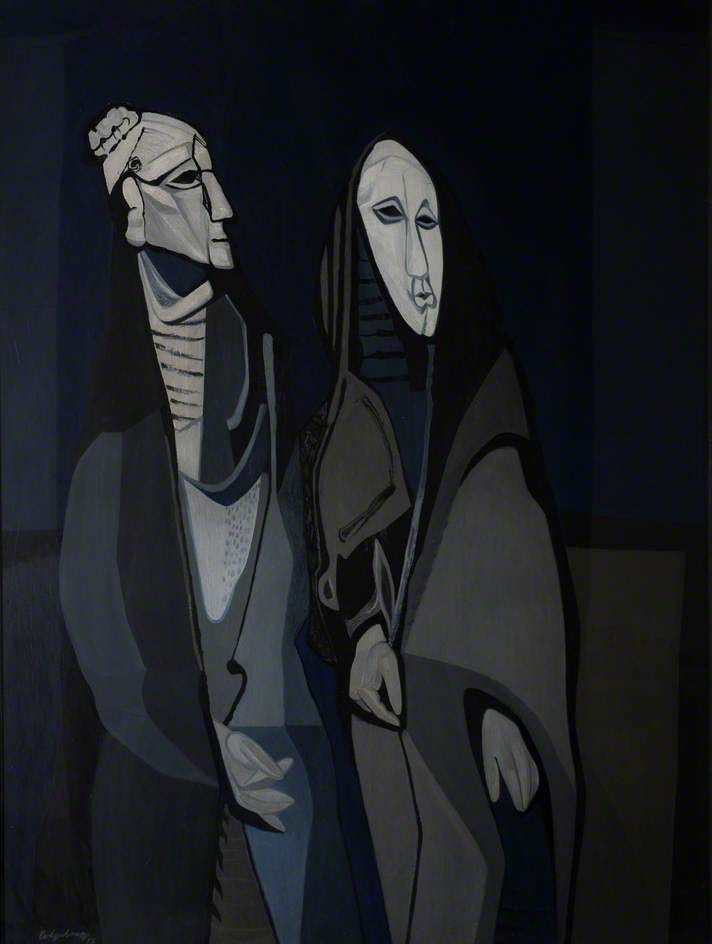
Knowing Robert Colquhoun had been taught in the same art rooms I had been taught in, and Davy before that, felt like a wee gem I carried around in my pocket. I only had to walk across the road to the Dick Institute in my lunch hour to see original work by him. One particular work, an oil painting called Women in Ireland, haunted me for years, burning its way into my synapses.
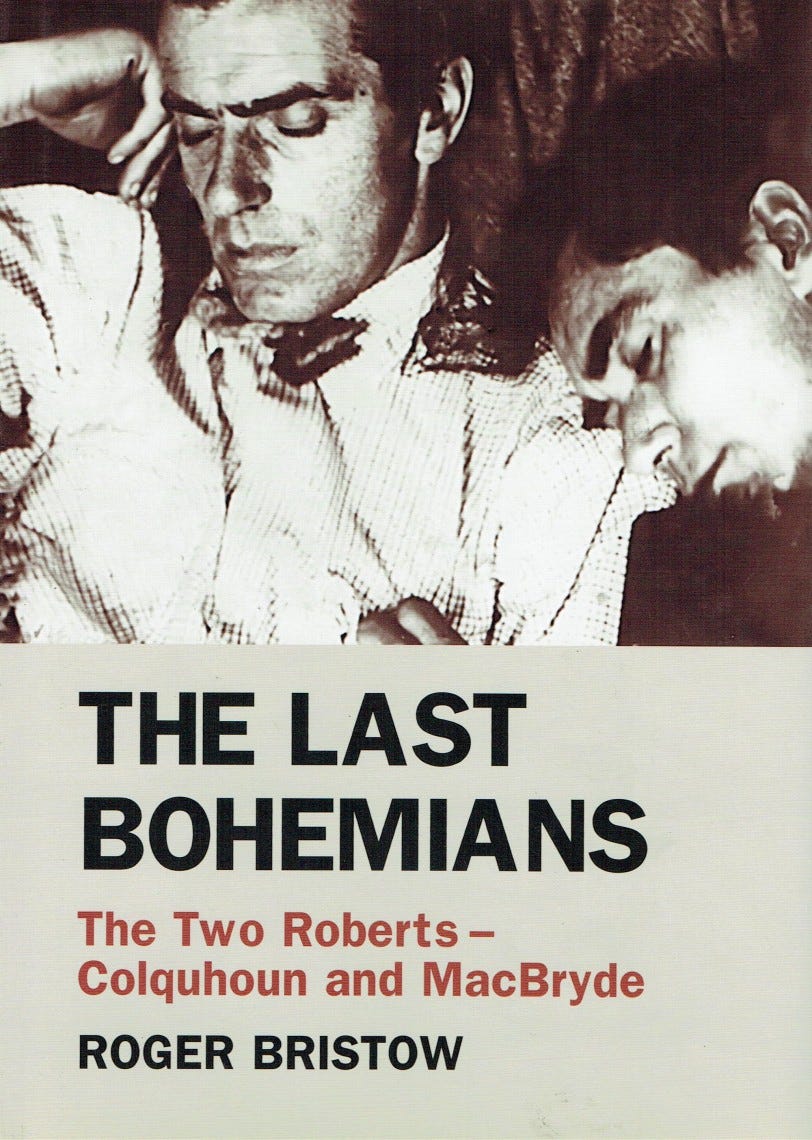
Around 15 years ago, I read a fascinating biography about the Roberts by Roger Bristow, The Last Bohemians, The Two Roberts – Colquhoun and MacBryde. The picture painted was as rumbustious as it was tragic. What lives these two men had lead. Worthy of a novel… surely? If only the right person was to come along and write it?
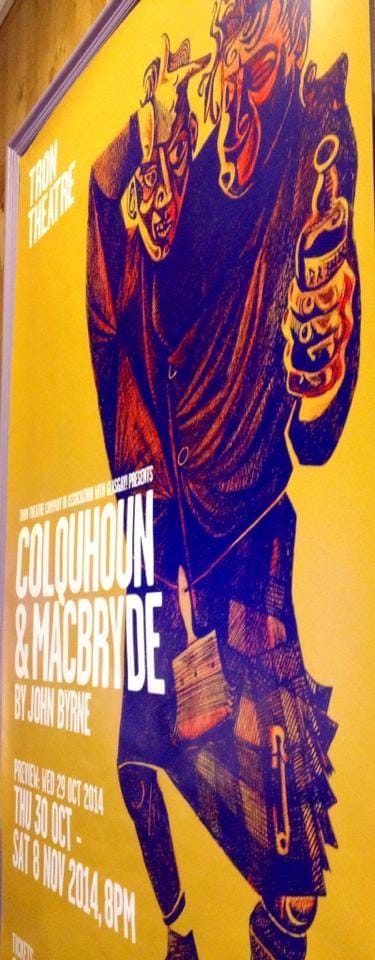
The late great John Byrne wrote a stage play about them, Colquhoun & MacBryde, first performed at London’s Royal Court in 1992. I saw a slimmed-down two handed version in 2014 at the Tron Theatre in Glasgow. It offered a fictionalised snapshot into their lives together, but I longed for more.
In late 2020, I privately messaged author and presenter, Damian Barr, on Twitter about Robert Colquhoun after we each made a passing reference to the Roberts.
I’d read Maggie & Me, Damian’s fantastic memoir – published in 2013 – about growing up as a bookish wee boy in working-class Lanarkshire. The picture Damian painted of coming of age as a young gay man during the Thatcher years was as vivid as it was revelatory. The scene he described of the after effects of drinking too much Buckfast lives with me still…
Damian said he was interested in Colquhoun and MacBryde’s story. As queer working class artists, they ‘spoke to his soul’. I knew instinctively what he meant and I knew he was the novelist to claim back these men and put them back out into the world for future generations.
I passed on a couple of reviews to Damian I’d written for The Herald after seeing exhibitions featuring their work at the Dick Institute in Kilmarnock in early 2014 and at the Scottish National Gallery of Modern Art in Edinburgh in late 2014. (See below for both texts in full.)
I also introduced him to Davy Brown – keeper of the Two Roberts’ flame – by email. We message sporadically, sharing tales of writerly angst.
While I still angst away, the Roberts have been quietly getting under Damian’s skin these last four years and he has been reimagining their lives together. Earlier this week, it was announced that Canongate had acquired Damian’s queer historical novel, The Two Roberts.
As Damian says: “The Two Roberts were charismatic art stars – collected by major galleries, photographed by Vogue, filmed by Ken Russell. But they lived as hard as they worked...scandal was no stranger.
“Dylan Thomas adored them. Francis Bacon wanted to be them. Elizabeth Smart hired them as nannies (perhaps unwisely).
“Two of the 20th century’s most brilliant artists. Almost forgotten. Until now.
“There are so many gaps in their story - so many questions unasked.
“My new novel is all about what it means to find your voice, to find love when it’s forbidden and to change the way the world sees.
“I’ve fallen in love with ‘The Two Roberts’. I hope you do too.”
I’m already there…
The Two Roberts by Damian Barr will be published in September 2025 by Canongate.
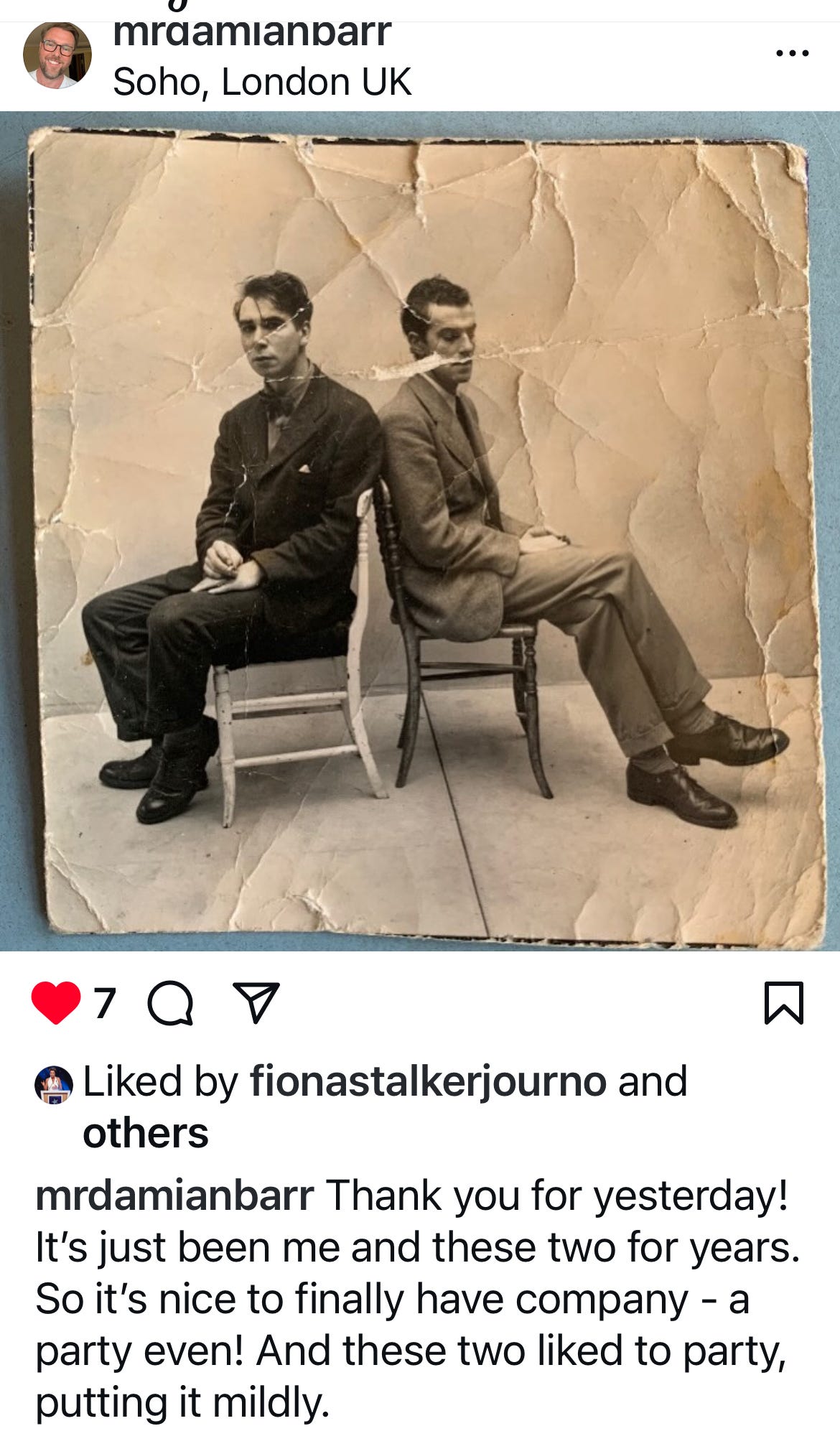
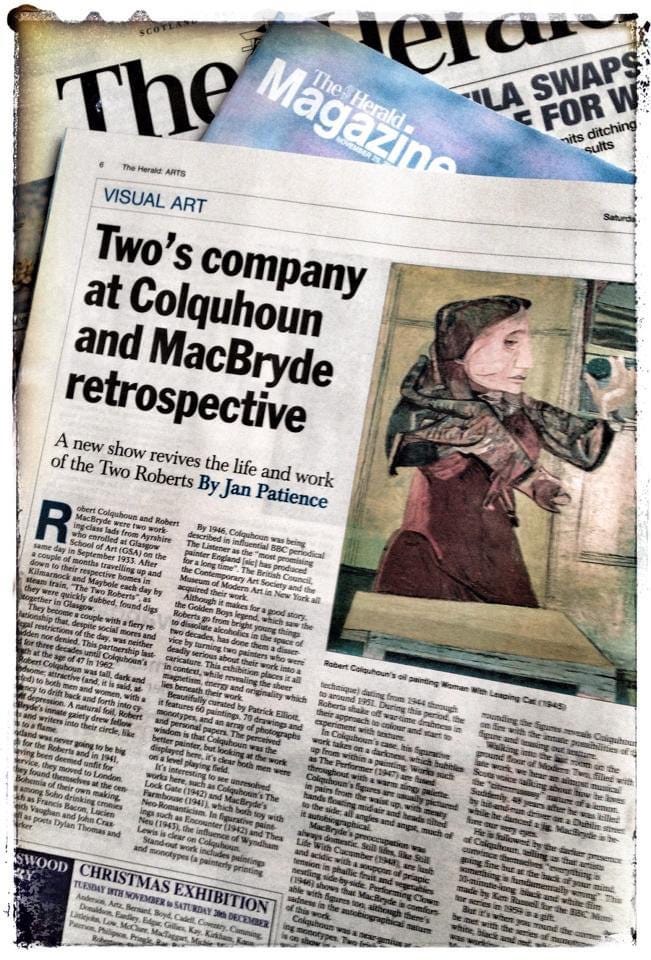
#1 Home town pays homage to the work of Robert Colquhoun
Written by me, Jan Patience, and published in The Herald on 25 January 2014
In the early hours of Thursday 20 September, 1962, at the age of just 47, Robert Colquhoun collapsed and died in a small private art gallery above a bookshop in Bloomsbury, London, where he was furiously working to a deadline ahead of an exhibition. Robert MacBryde, who had been attaching labels to the back of pictures in an adjacent room, came rushing through and cradled Colquhoun's head as his partner of almost 30 years took his last breath.
This fatal heart attack had been a long time coming. Both Colquhoun and MacBryde, the so-called Golden Boys of Bond Street, worked hard and partied hard and had been at the epicentre of Bohemian London life throughout the 1940s and 50s.
Bad news travels fast and in his home town of Kilmarnock, which Colquhoun hadn’t visited since 1946, news of his premature death quickly reached his old school, Kilmarnock Academy.
Artist Davy Brown remembers the moment well. “I was just 12 and had only just started at the school. I was in the art room and I remember my art teacher, Jock McKissock, looking shocked and saying, ‘Bobby Colquhoun’s dead!’
“I didn’t really know who he was talking about, but he told us Colquhoun was someone he’d known when they were both at Glasgow School of Art in the 1930s.”
Brown learned Colquhoun had also been a star pupil at Kilmarnock Academy in the late 1920s and early 1930s. Not long after that, pictures of his work started appearing around the picture rail in Room E8.
When he was just 14, Mr McKissock took Brown and his classmates to see a travelling Scottish Arts Council exhibition over the road from the school at the Dick Institute in Kilmarnock.
“There was a Colquhoun in it called Woman with Cat,” Brown recalls. “It was an amazing piece of work and I remember thinking: ‘I want to do that’.”
Fast forward to 1980 and I am a pupil of Davy Brown’s at Kilmarnock Academy and studying for an O-Grade in art. Around the walls of Room E8 are strange looking reproductions of paintings and prints which Brown has pinned up.
They are of higgledy-piggledy people, animals and still lifes and they all have a vivid black line, even if they are coloured or monochrome. All recognisable yet seemingly breaking all the rules of drawing as we are learning about it for our exam. The figures seemed tortured to my young untrained eye.
Soon, I’m looking at Colquhoun paintings and prints in my lunch break over the road at the Dick Institute. The memory of the work is indelibly etched on my mind.
Today, to celebrate the 100th anniversary of his birth in the Ayrshire town, a new exhibition of Robert Colquhoun’s work opens at the Dick Institute. I’ll be one of the first in line to see it. As will Davy Brown, who has spent the best part of 30 years collecting the work of the Ayrshire men known simply as The Two Roberts and acting as a champion now that most of the people who knew them are gone.
This exhibition precedes a major celebration of the work of The Two Roberts at the Scottish National Gallery of Modern Art in Edinburgh which will open in November this year. A selling exhibition is planned to take place around the same time at The Scottish Gallery in Edinburgh.
Brown, himself a highly collectable painter, is lending around 50 works to the National Gallery exhibition. He has also loaned several works to the Dick Institute, including what is thought to be Colquhoun’s last work.
The monotype, Astronaut, depicting an astronaut who dies in space, was completed shortly before Colquhoun's death in the Bloomsbury gallery.
The Dick Institute show will also include work from Colquhoun’s early career, including work he made at school.
As well as works by Colquhoun and MacBryde (who came from nearby Maybole), the Dick Institute is also showing a selection of artists who were contemporaries and influences on the Two Roberts, including; William Scott, Graham Sutherland, David Bomberg, Jankel Adler, William Johnstone, John Minton, William Gear, John Piper, John Keith Vaughan, Edward Baird, Michael Ayrton, John Maxwell, Ian Fleming, John Laurie, Alexander Law.
Loans from various institutions across the UK have also been secured.
This exhibition – and the ones in Edinburgh featuring both men’s work – will hopefully signal a resurgence in interest for The Two Roberts, whose work was feted way beyond the small towns in Ayrshire where they were born and raised.
In 1948, the curator of New York’s Museum of Modern Art bought work in London which summed up the new wave of British artists, known as The Neo-Romantics. He selected just five works; by Francis Bacon, Edward Burra, Lucian Freud, Robert Colquhoun and Robert MacBryde.
At the moment, there is no permanent recognition of Colquhoun’s legacy in his home town although various attempts have been made in the past to mark his connection to the town.
In 1972, a Robert Colquhoun Memorial Art Gallery opened within the Palace Theatre complex, but this is long gone. There was also an annual Robert Colquhoun competition which ran from 1972 until 1980.
Davy Brown hopes this will change. “It would be good if the centenary of Colquhoun’s birth prompted the local authority to put in place a permanent memorial to him in Kilmarnock,” he says.
“The very least East Ayrshire Council can do is provide a place where people can go and see his work. I’m sure if something permanent it would draw people to town. There’s tourism potential there apart from anything else.”
Brown is willing to put his pictures where his mouth is to make this happen, he says.
“If the conditions were right, I would happily give a large part of my collection of work by The Two Roberts on a permanent loan.”
Now, there is an offer not to be sniffed at. Meanwhile, while there is work on show by Colquhoun in his home town, I urge you to go see it.
#2 Two's company at Colquhoun and MacBryde retrospective
Written by me, Jan Patience, and published 29th November 2014
Robert Colquhoun and Robert MacBryde were two working class lads from Ayrshire who enrolled at Glasgow School of Art (GSA) on the same day in September, 1933.
After a couple of months travelling up and down to their respective homes in Kilmarnock and Maybole each day by steam train, The Two Roberts, as they were dubbed, found digs together in Glasgow. They quickly become a couple with a fiery relationship that, despite social mores and legal restrictions of the day, was neither hidden nor denied. This partnership lasted for three decades until Colquhoun’s death at the age of 47 in 1962.
Robert Colquhoun was tall, dark and handsome; attractive (and it is said attracted) to both men and women, with a tendency to drift back and forth into cycles of depression. A natural foil, Robert MacBryde’s innate gaiety drew fellow artists and writers into their circle, like moths to a flame.
Both were widely considered by their peers at GSA to be the most talented artists of their generation.
Scotland was never going to be big enough for the Roberts and in 1941, both having been deemed unfit for active service, they moved to London. There, they found themselves at the centre of a Bohemia of their own making, counting among Soho drinking cronies; artists such as Francis Bacon, Lucien Freud, Keith Vaughan, and John Craxton, as well as poets, Dylan Thomas and George Barker.
Throughout the early 1940s, they found inspiration for their art in the devastation around war-torn London and, in contrast, the countryside beyond. MacBryde, with his eye trained on the main chance, quickly developed a market for their paintings, which in the early years of the war were influenced by the Neo-Romanticism style of lyrical landscape painting as typified by Graham Sutherland and John Piper.
In 1943, the Roberts met Polish artist, Jankel Adler, a friend of Picasso and Paul Klee, who encouraged them to paint from memory and to examine their Scottish and Celtic roots.
Adler also had an interest in texture and his post-Cubist predilection for dividing objects into patterned forms inside a black grid – almost like stained glass – was much emulated by MacBryde. Adler’s favourite subjects; cats birdcages and beggars on crutches also found their way into both Roberts’ work.
By 1946, Colquhoun was being described in influential BBC periodical, The Listener, as the ‘most promising painter England [sic] has produced for a long time,’ while Vogue declared them ‘Tomorrow’s Names’ in the same breath as theatre director, Peter Brook, artist, John Minton and Joy of Sex author, Alex Comfort. The British Council, the Contemporary Art Society and The Museum of Modern Art in New York acquired their work.
Although it makes for a good story, The Golden Boys legend, which saw the Roberts go from bright young things to dissolute alcoholics in the space of two decades, has done them a disservice by turning two painters who were deadly serious about their work into a caricature.
This exhibition places it all in context, while revealing the sheer magnetism, energy and originality which lies beneath their work.
Beautifully curated by Patrick Elliot, it features 60 paintings, 70 drawings and monotypes, and an array of photographs and personal papers.
The perceived wisdom is that Colquhoun was the better painter, but looking at the work displayed here, it’s clear both men were on a level playing field.
It’s interesting to see unresolved works here, such as Colquhoun’s The Lock Gate (1942) and MacBryde’s Farmhouse (1941), which both toy with Neo-Romanticism. In figurative paintings such as Encounter (1942) and Thea Neu (1943), the influence of Wyndham Lewis is clear on Colquhoun.
Stand-out work includes paintings and monotypes (a painterly printing technique Colquhoun learned from Adler) dating from 1944 through to around 1951. During this period, the Roberts shake off war-time drabness in their approach to colour and start to experiment with texture. In Colquhoun’s case, his figurative work takes on a darkness, which bubbles up from within a painting. Works such as The Performer (1947), are fused throughout with a warm zingy palette. Colquhoun’s figures are usually pictured in pairs from the waist up, with meaty hands floating mid-air and heads tilted to the side. All angles and angst, much of it autobiographical. Perhaps in a nod to his bisexuality, in his painting, The Lovers (1947), the MacBryde ‘figure’ has morphed into a woman. MacBryde’s preoccupation was always domestic; still lifes, like Still Life with Cucumber (1948), are lush and acidic with a soupcon of priapic tension in phallic fruit and vegetables nestling side-by-side.
Performing Clown (1946) shows MacBryde is comfortable with figures too although there’s sadness in the autobiographical nature of this work.
Colquhoun was a near-genius at creating monotypes. Two Irish Women (1946), is on shown in a small section devoted to works he made following a trip to rural Ireland with MacBryde.
In this stunning version of a 1958 painting, Women in Ireland, (not on show here), two totem-like women are wreathed in blue-black shawls. The sootiness surrounding the figures reveal Colquhoun on fire with the innate possibilities of the figure and teasing out texture.
In 1951, with their fame receding as buyers’ and gallery owners’ attention turned to the US and abstract expressionism, the Roberts moved to the Essex countryside, where in exchange for looking after George Barker and his partner, writer, Elizabeth Smart’s’ four children, they received free bed and board.
They enjoyed success at the end of 1951 with a commission to create collaborative designs for a new ballet at the Royal Opera House, but gradually, their lives spiralled into a haze of alcohol-induced penury and homelessness.
As you walk into the last room on the ground floor of Modern Two, filled with late work, you hear an almost musical Scots voice talking about how he loves the ‘citrrrrussssy’ nature of a lemon. Suddenly, 48 years after he was killed by hit-and-run driver on a Dublin street while he danced a jig, MacBryde is before your very eyes.
He is followed by the darker presence of Colquhoun, telling you that artists convince themselves ‘everything is going fine but at the back of your mind, something is fundamentally wrong.’
This 10-minute-long black and white film made by Ken Russell for the BBC Monitor series in 1959 is a gift.
It’s when you round the corner to be met with the series of monotypes in white, black and red, which Colquhoun was working on when he died in MacBryde’s arms three years later, that you begin to get a cumulative sense of what the Roberts were really about.
Not before time.
Thanks for sharing Margaret!